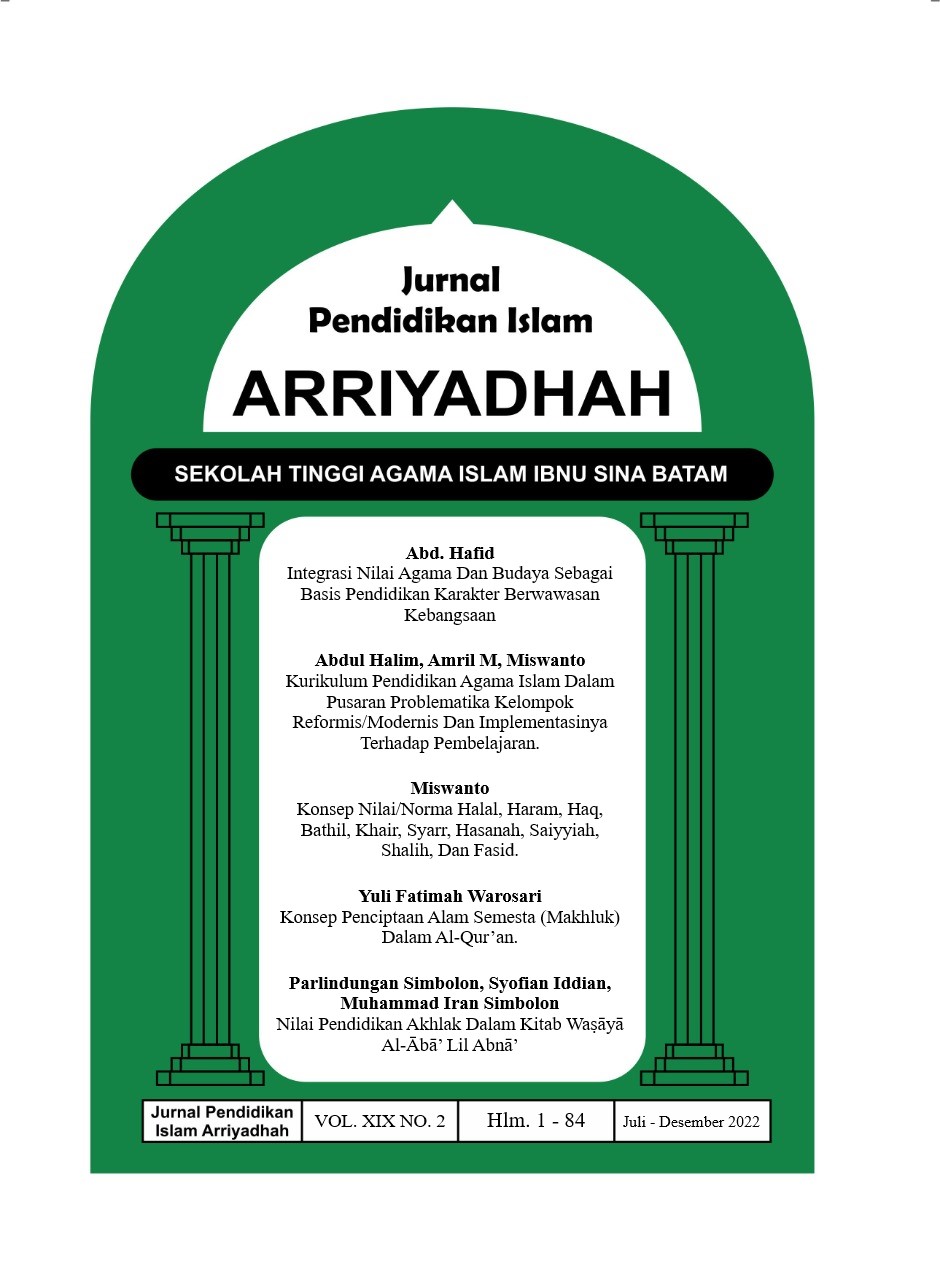
Integrasi Nilai Agama Dan Budaya Sebagai Basis Pendidikan Karakter Berwawasan Kebangsaan
Keywords:
Religious Values, Cultural Values, Character Building, National InsightAbstract
This journal aims to describe the combination of religious values and cultural values as the basis for character education for national insight. Religion is something that cannot be separated from human civilization, because religion is so close to being a tool in all rituals of human life. Therefore, religion is difficult to separate from the prevailing socio-cultural elements that surround it. There is not even a society without religion. If society is to last long, there must be a God to be worshipped. Religious life is a historical fact that is found throughout the history of humans and society in their personal lives as a peaceful, advanced, moving, developing, mutual interaction and social solidarity. Between society and culture, the two are intertwined and cannot even be separated. The meeting point between religion and culture can be seen that cultural actors are humans. Humans as actors and creators of culture and local wisdom, because the nature of humans themselves in the view of Islam, namely humans are awakened from the body and spirit. A human without a soul is only a lifeless body. The human body is composed of four elements, namely wind, water, earth and fire. The method used is a library research method by using a method to obtain information data by placing existing facilities in the library, such as books, magazines, documents, records of historical stories and internet media. The results of the study prove that the integration of religious values and cultural values through educational institutions will give birth to the humanization of education so that the basic values of tolerance, inclusiveness and pluralism become the basis for the formation of the character of national insight. Character education is not just teaching that focuses on the process of knowledge transfer, but in character education with national insight there is the formation of awareness and personality of students. To realize the character of national insight based on religious and cultural values in educational institutions, several forms of coaching can be carried out at school and on campus through various student activities at schools and campuses, both within the school environment and outside the school/campus. The forms of coaching include; National Defense Education (PBN), Scouting, and Mutual Cooperation.
References
Abdulsyani. (2007). Sosiologi Skematika, Teori, dan Terapan. PT Bumi Aksara.
Agus, B. (2007). Agama Dalam Kehidupan Manusia. Rajawali Press.
Al Syaibani, O. (2008). Falsafah Pendidikan Islami. Perdana Publishing.
Allport, G. W., & Vernon, P. E. (1931). A Study of Values, a Scale for Measuring the Dominant
Interests in Personality: Manual of Directions. Houghton Mifflin.
Asrida. (2017). Pembinaan Nilai Nasionalisme Siswa Melalui Kegiatan Ekstrakurikuler Pramuka
Di SMK Wahyu Makassar. Artikel Program Pascasarjana UNM Makassar.
Azra, A. (1999). Pendidikan Islam: Tradisi dan Modernisasi Menuju Milenium Baru. Logos Wacana
Ilmu.
Azra, A. (2014). Paradigma baru pendidikan nasional: Rekonstruksi dan demokratisasi. Penerbit Buku
Kompas.
Baidhawy, Z. (2007). Building harmony and peace through multiculturalist theology?based
religious education: An alternative for contemporary Indonesia. British Journal of Religious
Education, 29(1), 15–30.
Banks, J. A., & Rokeach, M. (1985). Teaching Strategies For the Social Studies: Inquiry, Valuing, and
Decision-Making. Addison-Wesley Pub. Co.
Chrisiana. (2015). Upaya Penerapan Pendidikan Karakter Bagi Mahasiswa. Studi Kasus di Jurusan
Teknik Industri UK Petra. Jurnal Teknik Industri, 1(7), 80–90.
Daradjat, Z. (1984). Dasar-dasar Agama Islam. Bulan Bintang.
Darmiyati Zucdi. (2015). Pendidikan karakter dalam perspektif teori dan praktik. UNY Press.
Darraz, M. A. (1985). Al-Nabâ’ al-‘Azîm Nazarîyah Jadîdah fî al Qur’ân. Dâr al-Thaqâfah.
Depdikbud. (2019). Kamus Besar Bahasa Indonesia. Balai Pustaka.
Dewey J. (2015). Democracy and Education (Fourth Edition). (New York : The Macmillan
Company).
Ditjen Dikdas. (2012). Panduan Pembinaan Pendidikan Karakter Melalui Pengembangan Budaya Sekolah
di Sekolah Dasar. Kemendikbud.
Durkheim, E. (1989). Sosiologi dan Filsafat (Terj. Soedjono Dirdjosisworo). Erlangga.
Edyar, B. (2003, March 31). UU Sisdiknas dan Pendidikan Pluralis-Multikultural. Kompas.
Gould, W. L., & Barkun, M. (2015). Social Science Literature: A Bibliography for International Law.
Princeton University Press.
Grasindo, T. (2017). UUD 1945 Republik Indonesia. Gramedia Widiasarana Indonesia.
Hongboontri, C., & Keawkhong, N. (2014). School Culture: Teachers’ Beliefs, Behaviors, and
Instructional Practices. Australian Journal of Teacher Education, 39(5), 1–16.
Intan, T., & Handayani, V. T. (2017). Penerapan Pendidikan Karakter Kebangsaan Melalui
Pembelajaram Berbasis Interkultural di Madrasah Aliyah Negeri Model Babakan
Ciwaringin Majalengka Cirebon. Jurnal Pengabdian Kepada Masyarakat, 1(5), 209–306.
Kartodijo, S. (1987). “Gotong—Royong: Saling Menolong Dalam Pembangunan Masyarakat Indonesia,
dalam Callette, Nat.J dan Kayam, Umar (ed), Kebudayaan dan Pembangunan: Sebuah Pendekatan
Terhadap Antropologi Terapan di Indonesia. Yayasan Obor.
Kluckhohn, C., & Kelly, W. H. (1944). The Concept of Culture.
Koentjaraningrat. (1987). Sejarah Teori Antropologi I. Universitas Indonesia.
Koentjaraningrat. (2000). Kebudayaan, Mentalitas dan Pembangunan. Gramedia Pustaka Utama.
Koentjaraningrat. (2012). Pengantar antropologi. Rineka Cipta.
Kropotkin, P. (2006). Gotong Royong Kunci Kesejahteraan Sosial; Tumbangnya Darwinisme Sosia.
Piramedia.
Kupperman, J. (2008). Six Myths about the Good Life: Thinking About What Has Value. Hackett
Publishing.
Lawang, R., M. Z. (2005). Kapital sosial: Dalam Perspektif Sosiologi Suatu Pengantar. FISIP UI Press.
Linton, R. (1947). The Cultural Background of Personality. Routledge.
Ma’arif, S. (2007). Revitalisasi pendidikan Islam. Graha Ilmu.
Majid, N. (2000). Masyarakt Religius: Membumikan Nilai-nilai Islam Dalam Kehidupan Masyarakat.
Pustaka Al-Kautsar.
Megawangi, R. (2004). Pendidikan Karakter: Solusi Yang Tepat Untuk Membangun Bangsa. Balai
Pustaka.
Muhaimin, A. M. (2015). Pemikiran Pendidikan Islam. Bumi Aksara.
Mukhibat, M. (2016). Meneguhkan Kembali Budaya Pesantren Dalam Merajut Lokalitas,
Nasionalitas, dan Globalitas. KARSA: Jurnal Sosial dan Budaya Keislaman, 23(2), 177.
Mulyana, R. (2011). Mengartikulasikan Pendidikan Nilai.
Pranadji, T. (2009). Penguatan Kelembagaan Gotong Royong dalam Perspektif Sosio Budaya
Bangsa. Jurnal Forum Penelitian Agro Ekonomi, IPB-Bogor, vol.27(1).
Rahman dkk, A. (n.d.). Corak Tasawuf dalam Kitab-Kitab Tafsir Karya K.H. Ahmad Sanusi. 1.
Saifuddin, A. F. (2016). Strategi Sosial Budaya bagi Bela Negara, Suatu Pendekatan Konseptual
(Majalah Wira). Puskom Publik Kemhan.
Sastrapratedja, D. M. (1993). Pendidikan Nilai Memasuki Tahun 2000. PT. Grasindo.
Siahaan, T. (2016). Bela Negara dan Kebijakan Pertahanan (Majalah Wira). Puskom Publik Kemhan.
Soepandji, B. S. (2012). Bangga Indonesia: Menjadi Komponen Cadangan Tanah Air. Grasindo.
Sujatna, R. R. (2018). Pengembangan Kultur Sekolah. Jurnal Pendidikan, 2(7).
Suryawati, M., &. (2003). Sosiologi 1. Erlangga.
Sutarmi, Raharjo, T. J., & Pramono, S. E. (2016). Implementasi Pelaksanaan Pendidikan Karakter
sebagai Landasan Wawasan Kebangsaan di SMK Negeri 1 Kendal Kabupaten Kendal.
Journal of Educational Social Studies, 5(2), 136–144.
Taneko, S. B. (1984). Struktur dan Proses Sosial, Suatu pengantar Sosiologi Pembangunan. Rajawali.
Tilaar, H. A. R. (2002). Pendidikan, kebudayaan, dan masyarakat madani Indonesia. Remaja
Rosdakarya.
Varenne, H. (2008). Culture, Education, Anthropology. Anthropology & Education Quarterly, 39(4),
–368.
Widiyanto, D., & Istiqomah, A. (2019). Pembinaan Kesadaran Bela Negara Melalui Budaya
Sekolah. JPKN: Jurnal Pendidikan Kewarganegaraan, 3(2), 133–143.
Young, K., Mack, W., & Raymond. (1959). Sosiology and Social Life. American Book Company.
Yunus, Abd. R. (2015). Nilai-Nilai Islam Dalam Budaya dan Kearifan Lokal. Journal Rihlah UIN
Alauddin Makassar, Vol. II(I).